
What Is SEO? A Guide to Ranking on Google for Business in 2026
Understand SEO from how Google works, core components, getting started, measuring results, and preparing your site for Google and AI search.
If you have looked for ways to grow sales or find customers through your website, you have probably heard the term SEO.
Some describe SEO as getting onto page one of Google. Others see it as writing articles stuffed with keywords. Some think it is a free traffic channel.
Those explanations are only partly right.
SEO is the process of improving your website, content, and trust signals so search engines understand what each page is about — and so your site has a better chance of appearing to people searching for related information, products, or services.
The goal should not stop at rankings. SEO should bring the right visitors, leads, sales, or other outcomes that matter to the business.
This article covers SEO from the basics — how Google works, core components, how to start, how to measure — through what has changed in the age of AI search.
What is SEO?
SEO stands for Search Engine Optimization. It means improving your website so search engines can discover, access, understand, and consider showing your pages in search results.
When users search for things like
- accounting firm Bangkok
- acne clinic near me
- bedroom air purifier
- packaging factory
- how to rank on Google
Google tries to show results that are relevant, useful, and aligned with what the searcher needs.
SEO increases the chance your website is among those results.
SEO spans many areas — from analyzing keywords, creating content, and structuring your site to speed, user experience, and building trust from your site and external sources.
What is organic search?
Organic search is the set of results Google shows without paid ad placements.
When users click those results, your site receives organic traffic.
You do not pay Google per click, but SEO is not cost-free. You still invest time, people, technology, content, and ongoing site improvements.
How does Google Search work?
Before doing SEO, understand how Google finds and processes pages.
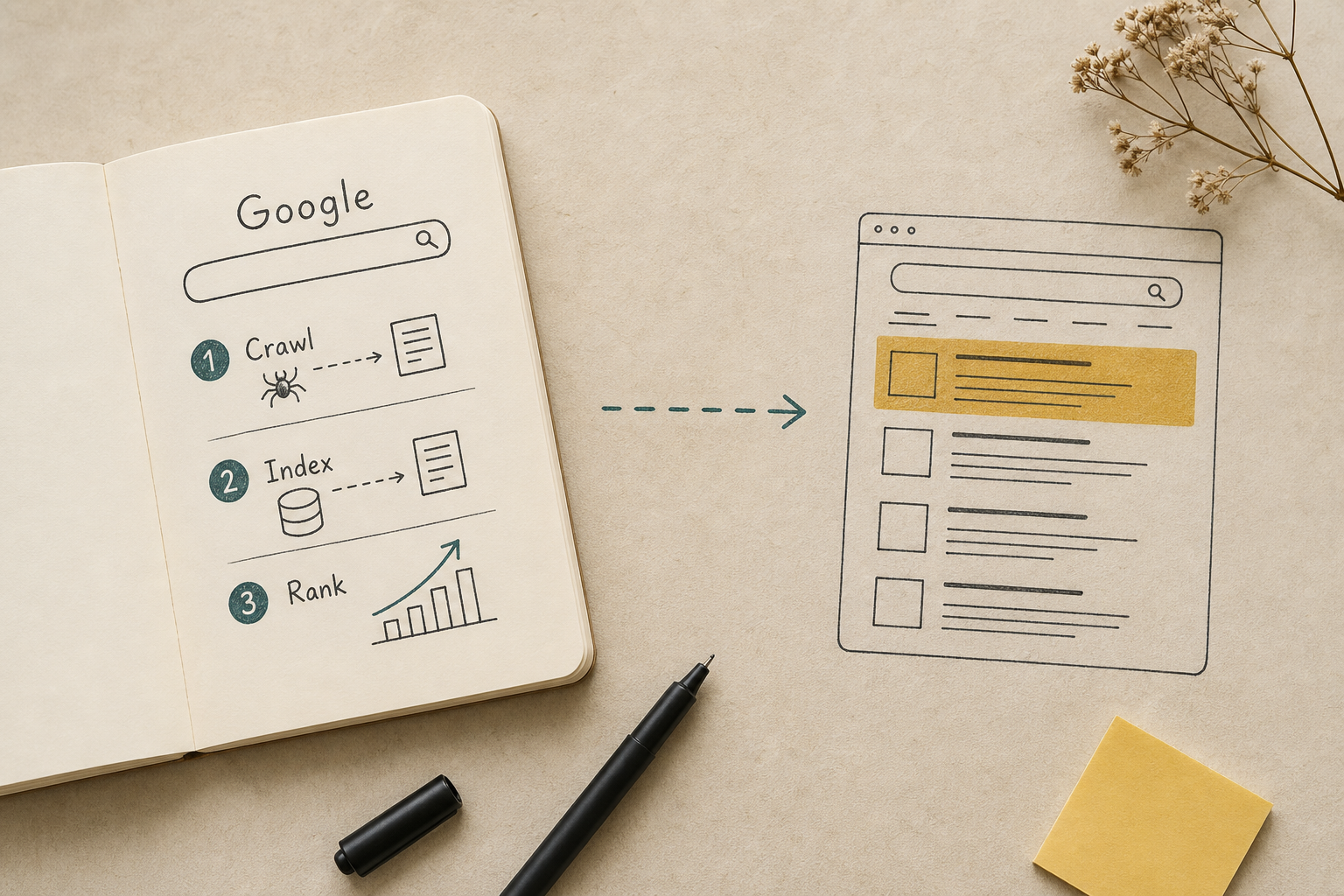
Google describes three main steps: crawling, indexing, and serving search results.
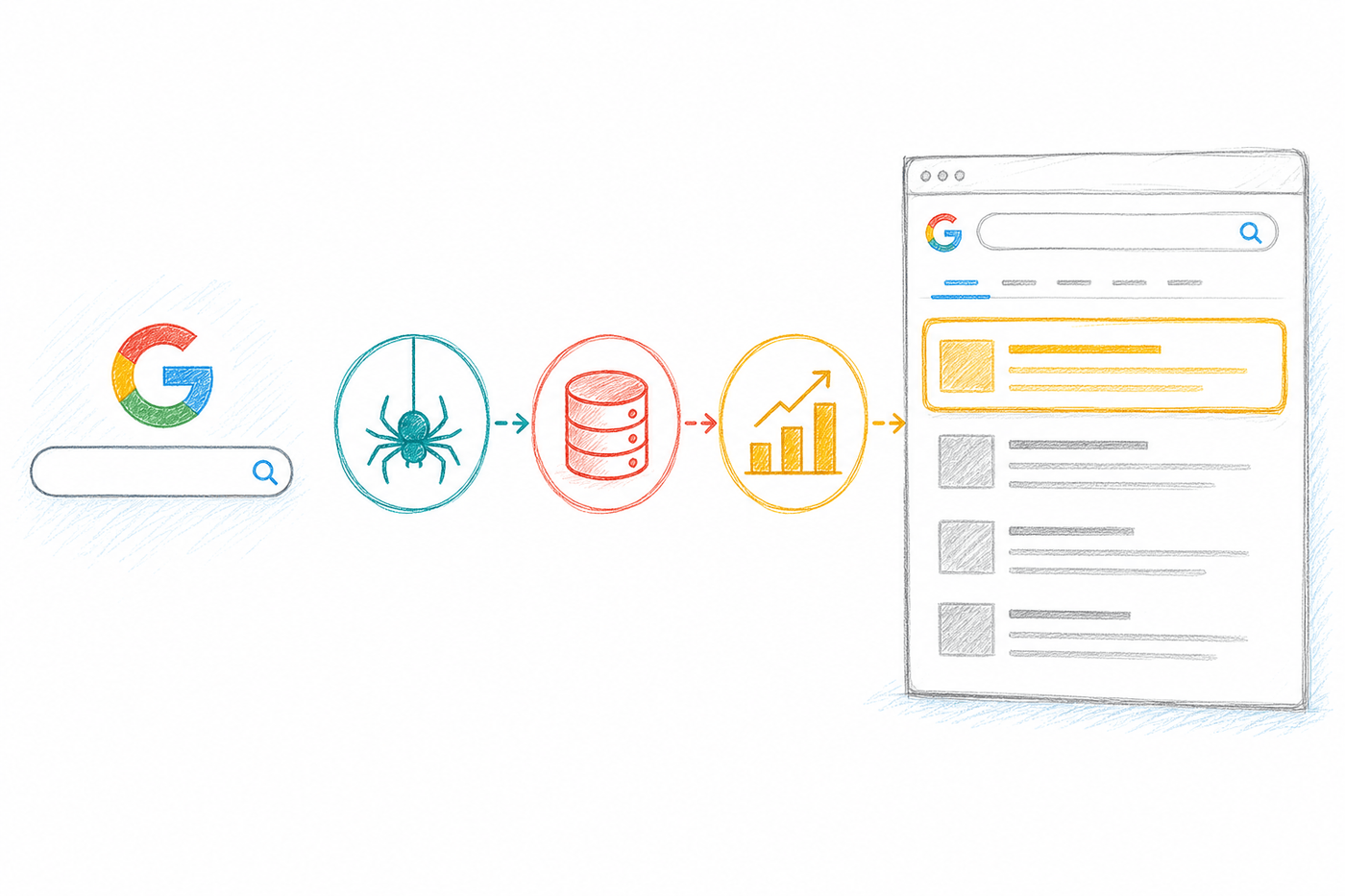
1. Crawling: Google explores your site
Google uses programs called Googlebot or crawlers to find and download page data.
Google may discover new pages from
- internal links on your site
- backlinks from other sites
- XML sitemaps
- pages Google already knows about
If Googlebot is blocked by robots.txt, the site returns errors, or content requires login, Google may not access the page.
2. Indexing: Google analyzes and stores information
After accessing a page, Google analyzes text, images, video, titles, headings, alt text, and other elements to understand what the page is about.
Google also considers whether content is original or duplicated elsewhere, and which URL should be the canonical version.
A crawl does not guarantee indexing. Low-quality, duplicate, or noindex pages may never enter the search index.
3. Serving and ranking: choosing results to show
When someone searches, Google selects pages from its index related to the query and ranks them using many factors.
Results may vary based on
- meaning and search intent of the query
- content quality and relevance
- searcher language and location
- device type
- freshness of information
- site trustworthiness
- on-page experience
Google does not publish its full ranking formula, and no single technique guarantees position one.
See Google Search Central for how search works.
Why does SEO matter for business?
SEO’s strength is reaching people when they already have intent.
Someone searching “accounting firm for SME” may be comparing providers. Someone searching “monthly bookkeeping cost” may be budgeting. Someone searching your company name may be close to a decision.
SEO helps your business appear across these customer journeys.
Reach people who are actively searching
Users initiate the search themselves — unlike some ads shown before demand exists.
When keywords and content match real services, search visitors are more likely to become quality customers.
Build long-term traffic
Ranking articles or service pages can bring visitors continuously without paying per click.
Rankings are not permanent. You must update information, maintain quality, and compete with new content.
Strengthen brand credibility
A site with complete information, credible references, and visibility on relevant queries helps audiences recognize your expertise.
SEO builds both traffic and brand authority.
Understand your market
Google Search Console shows
- what customers search for
- which problems draw interest
- which pages get impressions but few clicks
- which keywords start generating leads
- how demand is shifting
Use this to improve content, services, and marketing offers.
Reduce reliance on ads alone
Businesses that depend only on paid traffic need ongoing budget to maintain volume.
SEO does not replace all advertising, but it diversifies acquisition and builds marketing assets you own.
How many types of SEO are there?
Practitioners often group work into three areas: on-page SEO, technical SEO, and off-page SEO.
This is a planning framework, not an official Google taxonomy. All three must work together.
1. On-page SEO
On-page SEO improves content and elements within a page so users and search engines understand it more easily.
Key tasks include
- analyzing keywords and search intent
- creating content that answers user questions
- writing titles and meta descriptions
- structuring with H1, H2, and H3
- using short, descriptive URLs
- writing alt text for images
- linking internal pages
- keeping information accurate and current
- making pages easy to read and use
Search intent matters more than repeating keywords
Search intent is the reason behind a query.
Someone searching “what is SEO” wants fundamentals — they should find a guide or explanatory article.
Someone searching “SEO agency pricing” is evaluating providers — they should find a service page with scope, process, pricing, or how to request a quote.
Even with keywords in every slot, wrong intent makes competition hard.
What should quality content include?
Good content should
- answer the main question quickly
- cover necessary points
- use language your audience understands
- offer data or experience beyond generic articles
- separate facts from opinions
- cite original sources
- show author and update date
- avoid unnatural keyword stuffing
Google states there is no word count that automatically ranks well. Length should match what readers need — not beating competitors on length alone.
To systematize content production, see our content SEO service.
2. Technical SEO
Technical SEO maintains site structure and systems so search engines can access, process, and understand pages efficiently.
Important topics include
Crawlability and indexability
Confirm Googlebot can reach important pages, noindex is not accidental, and robots.txt does not block required resources.
Site structure
Organize pages logically. Users should reach key pages within a reasonable number of clicks.
Related pages should link with internal links to aid discovery and topical understanding.
XML sitemap
Sitemaps tell Google which URLs matter, but they do not guarantee crawl, index, or rankings.
Canonical URLs
Canonical tags identify the primary URL when similar pages exist, reducing confusion and signal split across URLs.
Mobile and page experience
Sites should work well on mobile — readable text, tappable controls, and no intrusive elements blocking main content.
Core Web Vitals
Core Web Vitals measure real-user experience in three areas
- LCP: how fast main content appears
- INP: responsiveness to interaction
- CLS: layout stability
Good scores do not guarantee rankings, but fast, stable sites help users access information.
HTTPS and security
Use HTTPS to protect data between users and your server. Maintain systems free of malware or hacked content.
Structured data
Structured data describes on-page information types and may enable certain rich result formats.
Schema must match what users actually see — do not add markup for content that is not on the page.
3. Off-page SEO
Off-page SEO covers signals and activity outside your site that build awareness and trust.
The most familiar element is the backlink — a link from another site to yours.
Valuable backlinks often come from
- trustworthy websites
- topically relevant content
- natural citations
- news, research, or original data
- digital PR
- partners and professional associations
More backlinks are not always better. Large volumes from spam or manipulative networks may add little value and create risk.
The goal is creating content others want to cite — not accumulating links regardless of source.
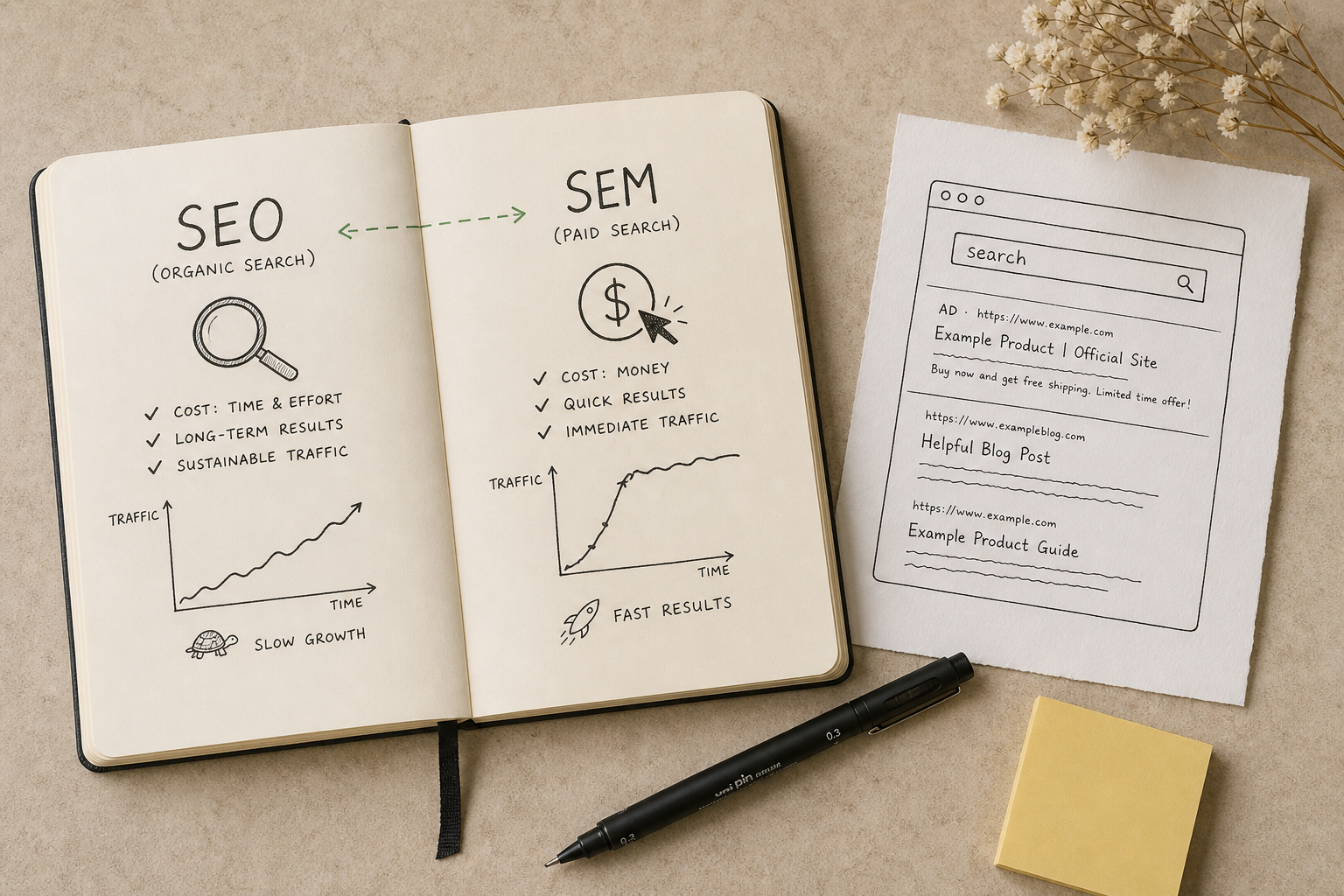
How is SEO different from SEM and Google Ads?
Traditionally, SEM (search engine marketing) covered both organic and paid search marketing.
In practice today, many people use SEM to mean paid search or Google Ads specifically.
| Topic | SEO | Google Ads |
|---|---|---|
| Result type | Organic search | Ad placements |
| Cost per click | No payment to Google per click | Auction-based ad spend |
| Speed | Builds over time | Can start faster |
| Traffic duration | May continue after pausing investment | Drops when campaigns stop |
| Control | Cannot control rank directly | More control over budget, targeting, and ads |
| Core work | Content, site, and authority | Keywords, bids, ads, and landing pages |
SEO and Google Ads are not mutually exclusive.
New businesses may use ads for short-term leads and keyword testing while investing in SEO for long-term channels.
Read more in SEO vs SEM: what’s the difference.
How to start SEO for your business
SEO has many details, but you can start systematically with these seven steps.
Step 1: Define business goals
Do not start with only “which keyword should we rank for?”
Define what SEO must produce first, such as
- more quote requests
- more branch phone calls
- more online sales
- lower cost per lead
- more trial signups
- awareness in a new market
Clear goals improve keyword, landing page, and metric choices.
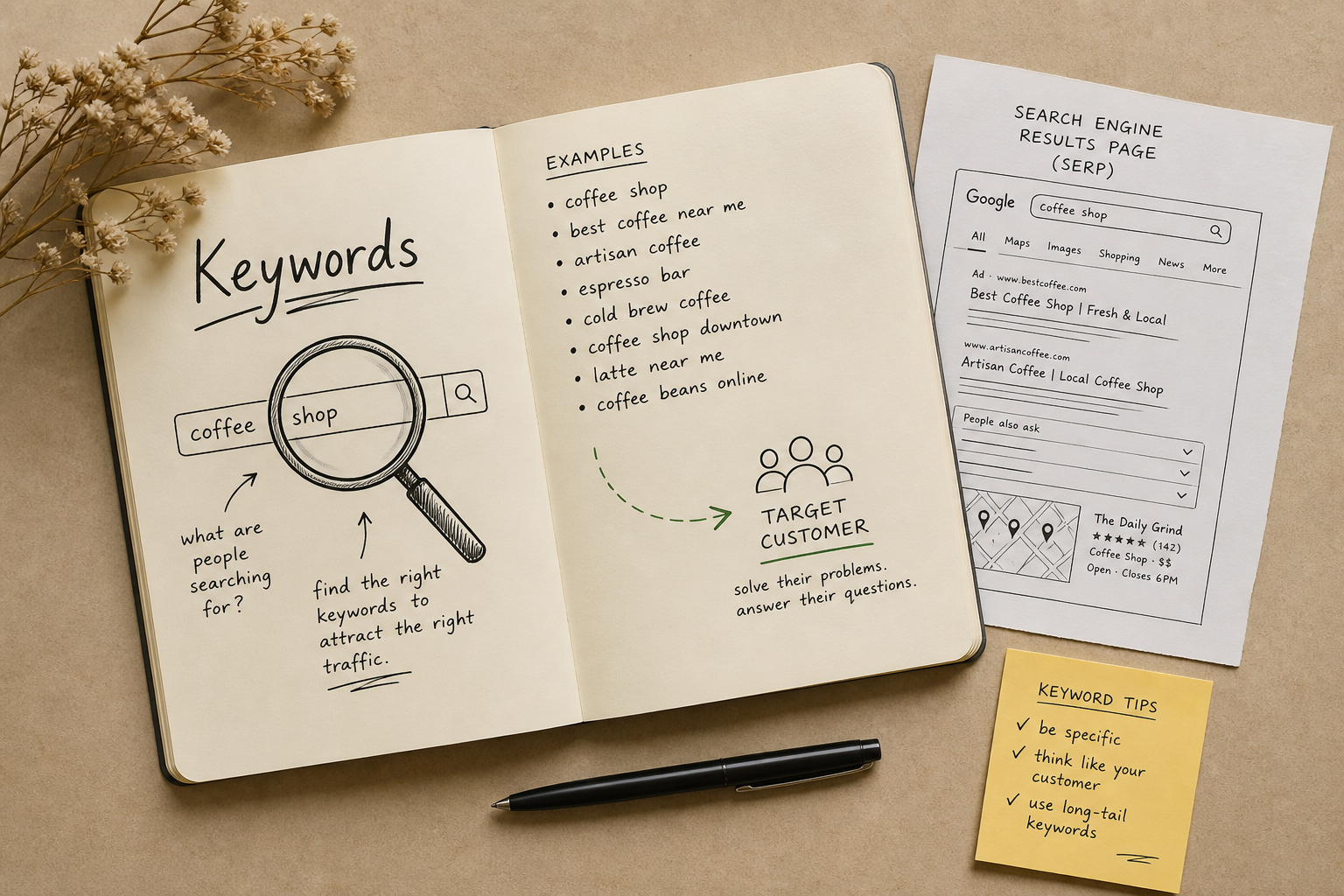
Step 2: Do keyword research
Keyword research finds and analyzes terms your audience actually searches.
Consider more than search volume
- search intent
- business relevance
- competition level
- revenue potential
- SERP format
- whether your site can produce strong content
A home builder might group keywords like this
Informational
- how to start building a house
- how to budget for a home build
- types of construction materials
Comparison
- build yourself vs hire a company
- prefab vs brick house differences
Ready to buy
- home builder Bangkok
- modern two-story house build price
- design-and-build company
Each group should map to pages matching intent — not one article competing for every term.
Continue with what is a keyword and what is a long-tail keyword.
Step 3: Plan site structure
Map keywords to pages — keyword mapping.
Example structure for an SEO agency
/en/services/seo— SEO services/en/services/technical-seo— technical SEO/en/services/content-seo— content SEO/en/services/backlinks— backlinks/en/blog/what-is-seo— what is SEO/en/blog/what-is-keyword— what is a keyword
Each page should have one clear primary goal. Multiple pages targeting the same intent can cause cannibalization.
Step 4: Build service pages and content that match intent
Service pages should answer decision-stage questions
- what the service covers
- who it is for
- how the process works
- typical timeline
- how results are measured
- case studies or proof
- how to contact or start
Articles should answer pre-purchase questions, build understanding, and link to relevant service pages.
Do not write articles only because a keyword has volume if the topic does not support your services or customer journey.
Step 5: Optimize on-page SEO
Check key elements on each page
- unique, descriptive title
- one primary H1
- introduction answers intent quickly
- H2 and H3 aid scanning
- readable, memorable URL
- appropriately sized images
- meaningful alt text
- internal links with clear anchor text
- call to action aligned with customer stage
You do not need the exact keyword in every heading. Natural writing and topical coverage matter more.
Step 6: Audit technical SEO
At minimum, check
- target pages return HTTP 200
- no accidental
noindex - Googlebot can access pages
- canonical points to the correct URL
- sitemap lists only URLs you want indexed
- no critical broken links
- mobile-friendly
- images not excessively large
- Core Web Vitals in reasonable range
- structured data without errors
- HTTPS enabled
Technical problems can waste good content.
Step 7: Build authority and measure results
Publish content worth citing, such as
- data from real work
- case studies
- surveys
- free tools
- templates
- checklists
- expert commentary
Then track and improve continuously. SEO is not a one-time project.
For end-to-end strategy and execution, see our SEO services.
How do you measure SEO?
Rankings and traffic are only part of the picture.
Measure SEO from visibility through to revenue.
Visibility on Google
Track in Google Search Console
- impressions
- clicks
- CTR
- average position
- queries
- landing pages
- indexing status
On-site behavior
Track in GA4 or your analytics stack
- organic sessions
- engaged sessions
- pages viewed
- key events
- form submissions
- phone or LINE clicks
Business outcomes
Metrics that often matter more than raw traffic
- qualified leads
- conversion rate
- cost per lead
- customer acquisition cost
- revenue from organic search
- pipeline value
- return on investment
Traffic growth without customers may mean wrong keywords, weak landing pages, or incomplete conversion tracking.
How long does SEO take?
There is no timeline that fits every site.
Google notes some changes may reflect within hours; others take months.
Duration depends on
- site age and history
- competition level
- existing content quality
- technical issues
- brand trust
- resources invested
- update frequency
- keyword types
A new site competing on broad terms against large brands may take longer than a site with an existing base targeting long-tail keywords aligned with expertise.
Do not trust guarantees of position one or fixed short timelines.
How much does SEO cost?
Cost depends on site size, market, and scope.
Expenses may include
- SEO audit
- keyword research
- content strategy
- writing and editorial review
- web development
- technical SEO
- digital PR
- analytics tools
- in-house team or agency
Small businesses can start with pages closest to revenue — not fixing everything at once.
Evaluate ROI through customers acquired, lifetime value, and acquisition cost — not article or backlink counts alone.
Is SEO still important in the age of AI search?
Yes — but search behavior is changing.
Users may get answers from Google AI Overviews, AI Mode, ChatGPT, Perplexity, or other assistants before clicking a website.
Generic summaries of other sources matter less. Original data, real experience, and expert perspective matter more.
Google states generative AI search still relies on the search index and existing quality systems. Core SEO principles still apply
- sites must be crawlable and indexable
- content must be useful and uniquely valuable
- structure must be clear
- pages must work well for users
- key information should be available as text
- internal links must aid discovery
- images and video should be high quality
- structured data must match real content
How to make content fit AI search?
Write for humans first — not to trick AI.
Practices that help
- Answer the main question directly
- Use headings that describe content clearly
- Break long answers into steps or lists
- Cite sources for facts
- Add first-hand experience
- Explain limits and conditions
- Show author and update date
- Connect content in topic clusters
- Keep pages fast and accessible
- Keep business information consistent
You do not need a separate page for every question variant — search systems better understand synonyms and natural language.
Google also states there is no requirement to create llms.txt or special schema solely to appear in generative AI search.
See Google: Optimizing for generative AI features.
Common misconceptions about SEO
SEO means buying rankings
False.
Google does not sell organic rankings. Paid placements are Google Ads, not SEO.
More keywords means better rankings
False.
Keywords help describe content, but unnatural repetition may be keyword stuffing and hurts readability.
Longer articles always rank better
Not necessarily.
Length should match the question. Completeness, clarity, and unique value beat word count.
More backlinks always win
Not always.
Link quality, relevance, and context matter more than raw volume.
A beautiful site means good SEO
Not required.
A pretty site can be slow, poorly structured, or inaccessible to Google. Design must work with content and technical systems.
SEO is a one-time project
False.
Competitors change, content ages, search behavior shifts, and Google updates systems. SEO needs periodic review and improvement.
E-E-A-T is a direct ranking score
It is not a single score you can check or increment directly.
Showing experience, expertise, trust, and transparency helps users judge quality and aligns with what Google’s quality systems seek.
SEO checklist for business owners
Use this list to audit site basics.
Strategy
- clear business goals
- defined target customers
- keywords tied to real products and services
- primary search intent per page
- no unnecessary duplicate competition between pages
Content
- clear title and H1
- introduction answers the main question
- accurate, updated content
- information differentiated from competitors
- author attribution
- internal links
- appropriate calls to action
Technical SEO
- HTTPS
- mobile-friendly
- fast pages
- Googlebot can access pages
- important pages indexed
- correct canonicals
- updated sitemap
- no critical broken links
- appropriate image size and alt text
Measurement
- Google Search Console installed
- GA4 or analytics installed
- form submission tracking
- phone and contact channel tracking
- qualified leads separated from general leads
- reports connecting SEO to business outcomes
DIY SEO or hire an agency?
Both can work — depending on resources and complexity.
DIY SEO fits when
- the site is small
- you have time to learn and experiment
- the team knows customers and content well
- technical work is straightforward
- budget is limited
Hiring experts fits when
- the market is highly competitive
- the site has technical problems
- site structure needs a rebuild
- the team lacks time to produce and review content
- you need lead and revenue measurement systems
- past SEO efforts did not produce results
Before choosing a provider, ask about process, deliverables, measurement, case examples, and risks of techniques used.
Avoid guarantees of position one, opaque methods, or selling large backlink packages without caring about site quality.
Summary
SEO helps search engines discover, understand, and consider showing your site to users searching for related information, products, or services.
Effective SEO covers three areas
- on-page SEO: content and on-page elements
- technical SEO: structure and site performance
- off-page SEO: trust and external references
The end goal is not keyword rankings or traffic alone.
Good SEO reaches the right audience, creates qualified leads, grows sales, and lowers long-term acquisition cost.
In AI search, these foundations still matter. What changes is that generic content without new insight competes harder — businesses must build from expertise, experience, and information readers cannot find in ordinary articles.
To turn your website into a customer channel, see scope and approach at our SEO services.
Frequently asked questions
What is SEO?
SEO is the process of improving your website, content, and trust signals to increase the chance your site appears in organic search when people look for related information, products, or services.
Is SEO free?
Organic search clicks do not incur ad fees, but SEO still requires investment in time, people, tools, content, or expertise.
How long does SEO take?
There is no fixed timeline. Some changes may show results within weeks, but competitive markets or new sites often need several months.
How is SEO different from Google Ads?
SEO builds visibility through organic results over time. Google Ads uses ad budget to start showing results faster.
Can you do SEO yourself?
Yes. Start with keyword research, content that matches search intent, a site Google can access, and measurement via Google Search Console.
Is SEO still important in the AI era?
Yes. Google’s AI search systems rely on pages that are discovered, accessed, and stored in search. Core SEO remains the foundation of visibility.