

What Is Grey Hat SEO? Should You Use It for Long-Term Google Growth?
Grey hat SEO explained for business owners: how it differs from white hat and black hat, the risks, whether it still works in 2026, and which approach to choose.

If you have researched what SEO is, you have probably heard the terms white hat, grey hat, and black hat SEO.
Many people treat grey hat SEO as a shortcut to faster rankings.
Some believe it can still work if used carefully.
Others avoid it entirely because they fear Google penalties.
So what is actually true?
This article explains what grey hat SEO is, how risky it is, and which approach business owners should choose if they want sustainable results.
What is grey hat SEO?
Grey hat SEO sits between white hat SEO and black hat SEO.
These techniques may not clearly break Google’s rules, but they aim to rank faster without primarily creating user value. If Google updates its algorithm or policies, grey hat tactics can lose value or become risky for your site.
Put simply:
grey hat SEO may work for a while, but nobody can guarantee it stays safe long term.
How do white hat, grey hat, and black hat SEO differ?
| Type | Goal | Risk | Sustainability |
|---|---|---|---|
| White Hat SEO | Create user value | Low | High |
| Grey Hat SEO | Speed rankings with borderline tactics | Moderate | Moderate to low |
| Black Hat SEO | Manipulate algorithms | Very high | Low |
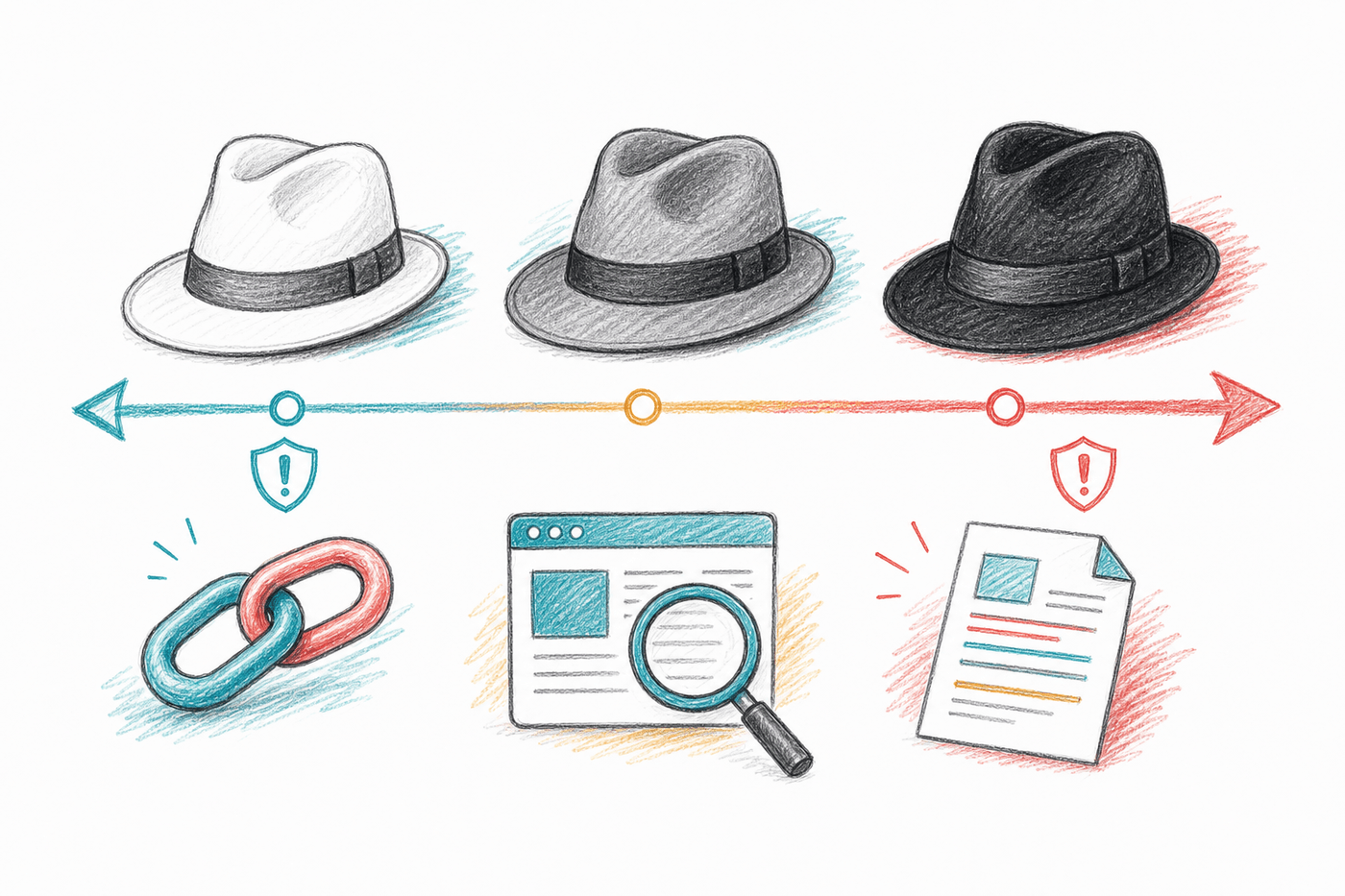
Businesses that want to build a brand and generate customers long term usually choose white hat SEO because it adapts better to Google’s changes. For fundamentals first, read what SEO is and explore SEO services built around sustainable strategy.
Examples of grey hat SEO techniques
Techniques often grouped as grey hat include:
Buying large volumes of low-quality backlinks
Buying backlinks is not always wrong, but building many links from irrelevant or low-quality sites carries a real risk of devaluation later.
Using expired domains for authority
Buying aged domains with past rankings and pointing them at your main site is a tactic seen in highly competitive industries.
Subtle keyword stuffing
Cramming keywords beyond what the content needs — even when it still reads okay — can hurt content quality.
Unreviewed AI content
Google does not ban AI-assisted content, but publishing large volumes without editorial review can reduce accuracy and usefulness — a risk to site quality. Strong content SEO strategy includes human review and search-intent alignment.
Parasite SEO
Publishing on high-authority third-party sites to rank quickly has become more controversial as Google tightened Site Reputation Abuse policies.
Why do people still use grey hat SEO?
Because sometimes it works fast.
Especially in highly competitive spaces like gambling, casinos, or affiliate marketing — where some operators accept risk in exchange for quicker rankings.
What works for short-lived sites is not necessarily right for a company building a brand for the long term.
Does grey hat SEO still work in 2026?
Google keeps refining its algorithms, and the line between grey hat and black hat is narrowing. Many tactics that once worked are now devalued or carry more risk.
That means relying on “beat the algorithm” tricks alone is more likely to hurt than help.
Is AI content grey hat SEO?
Not necessarily.
Using AI does not automatically make your site grey hat.
What Google cares about is whether content is:
- Useful
- Accurate
- Aligned with search intent
- Supported by real expertise or experience
If AI is a drafting tool and experts review the output, that is not inherently against Google’s direction.
How does Google detect grey hat SEO?
Google uses both algorithms and manual review in some cases.
Signals that may be considered include:
- Unnatural backlink patterns
- Excessive keyword use
- Large volumes of low-quality content
- Behavior that prioritizes ranking manipulation over users
If Google believes a site is trying to distort search results, rankings can drop — and in some cases you may receive a manual action.
How can you tell if an agency uses grey hat SEO?
If you are evaluating SEO services, ask:
- Where do backlinks come from?
- How is content produced?
- Is AI output reviewed by humans?
- What reporting do you receive?
- How is success measured?
- What is the plan if Google updates its algorithm?
If answers are vague or rankings are guaranteed on a short timeline, proceed carefully.
Which SEO approach should you choose?
For business websites that need leads and credibility, the best path is usually:
- Content that matches search intent
- Better user experience
- A fast, well-structured site — if the foundation is not ready, start with building a website yourself or design that supports SEO from day one
- Technical SEO
- Natural backlink growth
- Continuous measurement and improvement
It takes longer, but results tend to be more stable.
Summary
Grey hat SEO uses tactics between white hat and black hat approaches, aiming to rank faster on Google through methods that sit in a legal and policy grey area.
Some techniques may deliver short-term gains, but uncertainty and risk rise whenever Google’s algorithms change.
For businesses that want their website to become a long-term customer channel, investing in quality content, user experience, and sustainable SEO usually pays off more — because the real goal of SEO is not just rankings, but trust, the right visitors, and steady business growth.
Frequently asked questions
What is grey hat SEO?
Grey hat SEO uses techniques between white hat and black hat SEO. They may not clearly violate Google's rules, but they aim to rank faster without primarily creating user value — and they can become risky when algorithms or policies change.
How do white hat, grey hat, and black hat SEO differ?
White hat SEO focuses on user value with low risk and high sustainability. Grey hat SEO uses borderline tactics to speed up rankings with moderate risk. Black hat SEO tries to manipulate algorithms with high risk and low sustainability.
Is grey hat SEO against Google's rules?
Some techniques are not explicitly banned, but they are not approaches Google encourages — and they can become risky if policies change.
Does grey hat SEO work faster?
Some techniques may produce results faster than white hat SEO, but there is no guarantee those rankings will last long term.
Does grey hat SEO still work in 2026?
Google keeps refining its algorithms, and the gap between grey hat and black hat is narrowing. Many tactics that once worked are now devalued or carry more risk.
Is AI content considered grey hat SEO?
Not necessarily. Using AI does not automatically make a site grey hat. Google cares whether content is useful, accurate, and answers search intent. If AI drafts are reviewed by experts, that is not an inherently problematic approach.
How does Google detect grey hat SEO?
Google uses algorithms and, in some cases, manual review. Signals may include unnatural backlink patterns, keyword stuffing, large volumes of low-quality content, and behavior that prioritizes ranking manipulation over user value.
How can you tell if an agency uses grey hat SEO?
Ask where backlinks come from, how content is produced, whether AI output is reviewed by humans, what reporting you receive, how success is measured, and how they respond to algorithm updates. Vague answers or guaranteed fast rankings are red flags.
What is parasite SEO?
Parasite SEO publishes content on high-authority third-party sites to rank quickly. Google's Site Reputation Abuse policies have made this approach increasingly risky.
Should a typical business use grey hat SEO?
If you are building a brand and want a website that grows sustainably, investing in quality-first SEO is usually the better choice.
If competitors use grey hat SEO, should you copy them?
No. SEO competition should be judged against your long-term business goals, not short-term ranking spikes.
Which SEO approach should you choose?
For business websites that need leads and trust, the right path is content that matches search intent, strong user experience, technical SEO, natural backlinks, and continuous measurement.