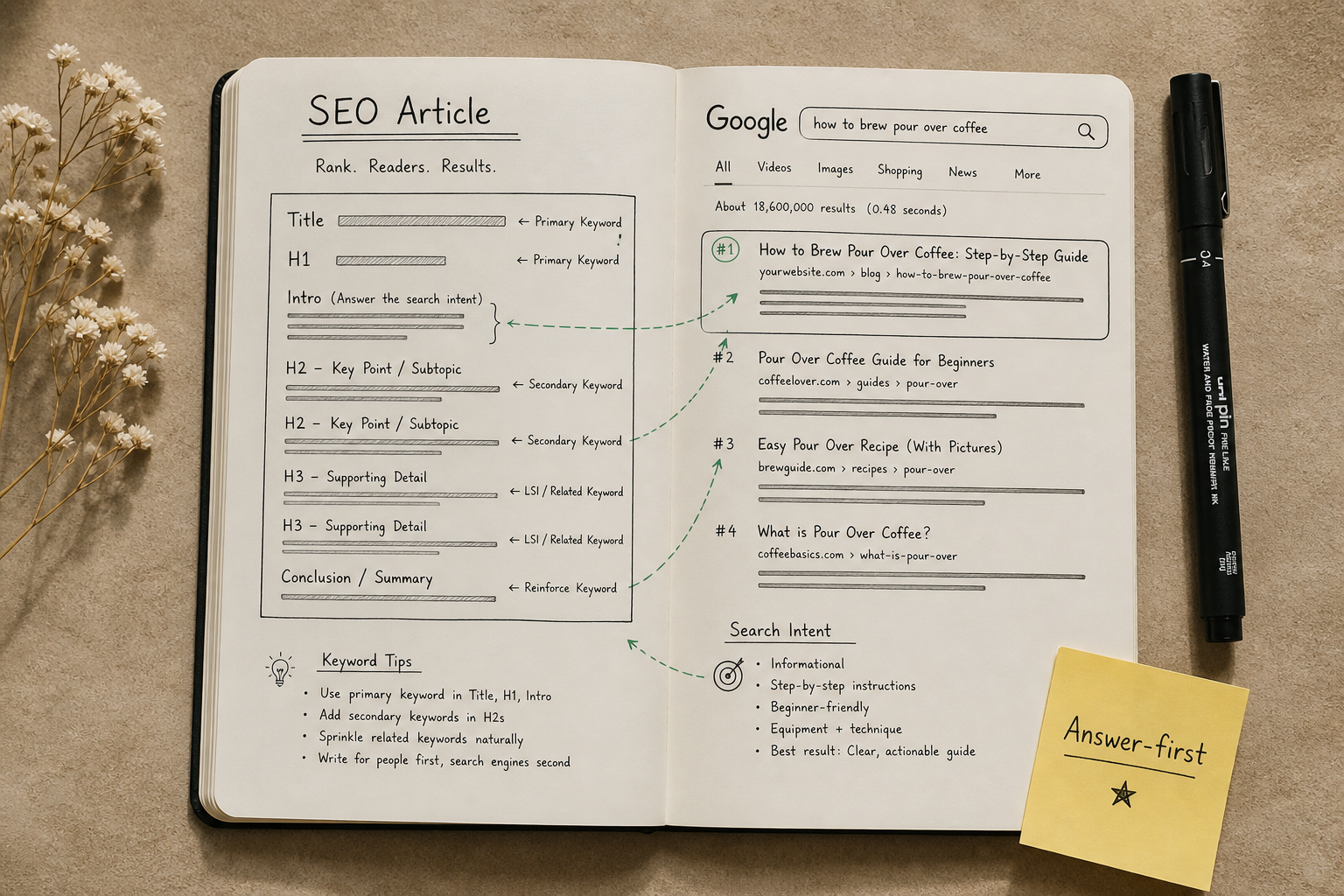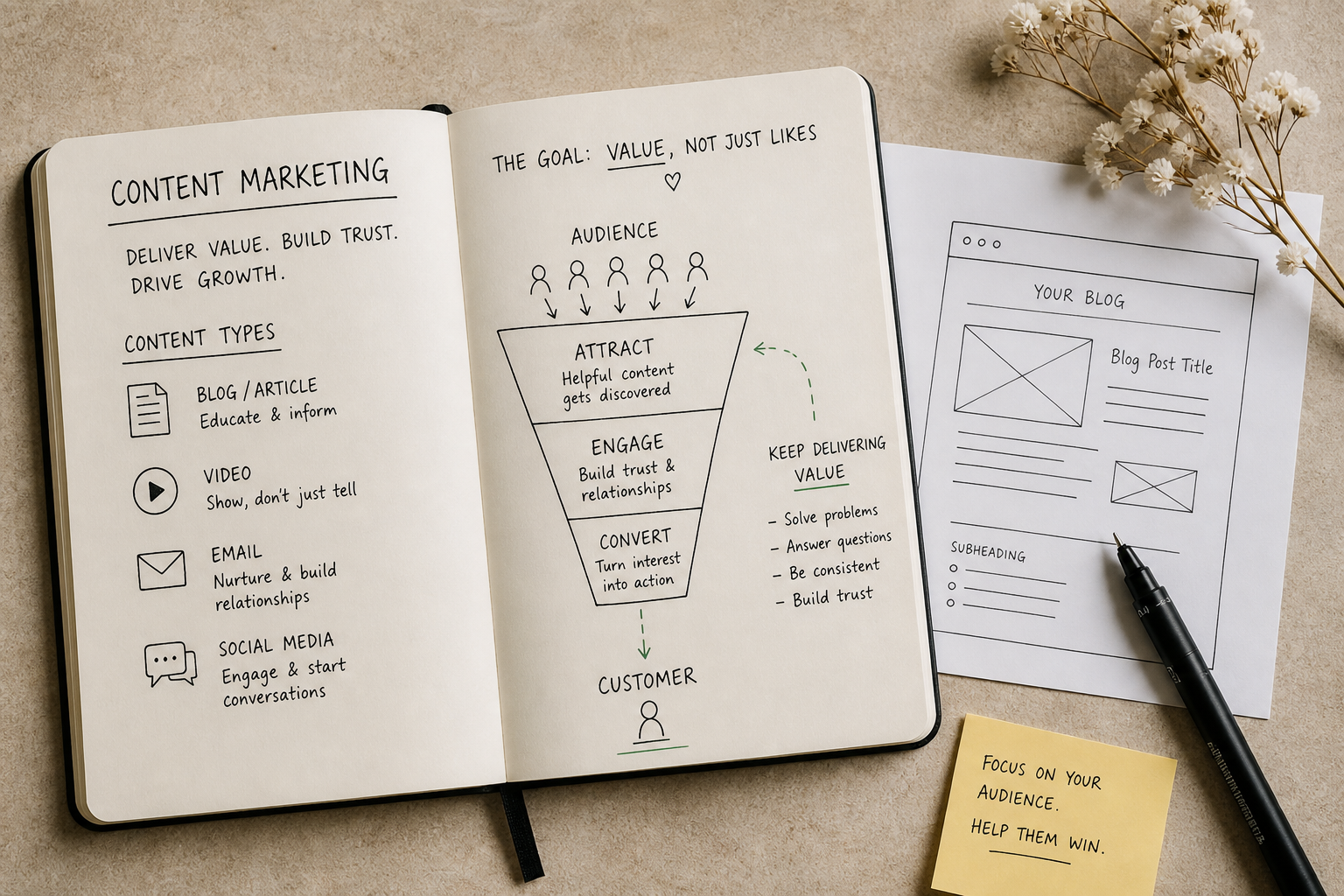


What Is GEO? Generative Engine Optimization Guide for 2026
What GEO is, how it differs from SEO, and how to prepare content for Google AI Overviews, AI Mode, ChatGPT, and Perplexity — without relying on unproven tactics.
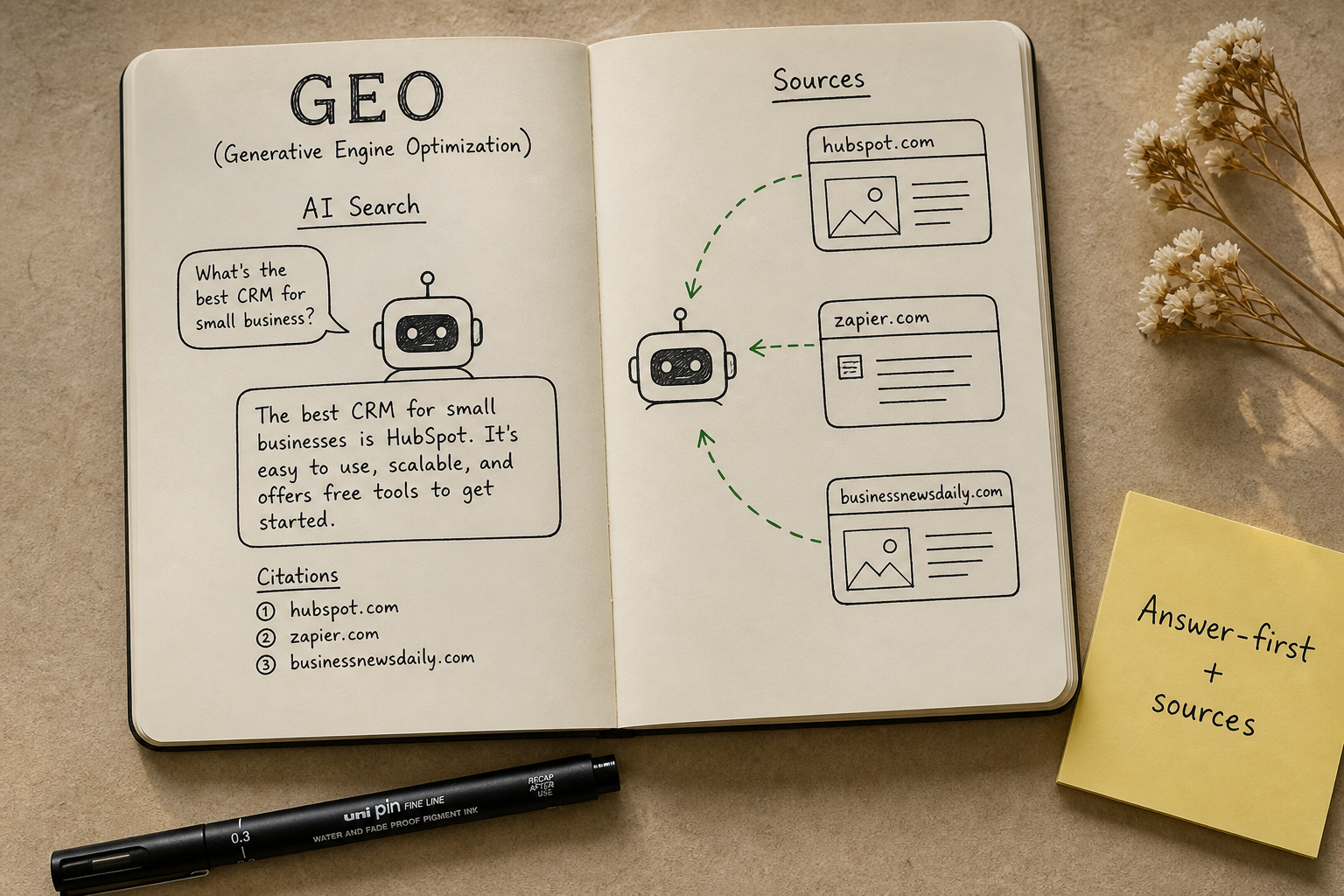
Search behavior is shifting from short queries on Google to full-sentence questions in Google AI Overviews, AI Mode, ChatGPT, and Perplexity.
Instead of only a list of links, users may get answers synthesized by AI from multiple sources, with reference links for further reading.
That shift created the term GEO.
GEO, or Generative Engine Optimization, is improving content, your website, and brand information to increase the chance generative AI systems discover, understand, and cite or use your information in answers for users.
GEO is not a secret formula to make AI mention your brand, and no one can guarantee which site external systems will choose.
In practice, GEO brings together SEO fundamentals, content strategy, technical accessibility, brand authority, and AI visibility measurement.
This article explains what GEO is, how it differs from SEO, how AI systems choose sources, and how businesses should start without wasting time on tactics with no evidence behind them.
What is GEO?
GEO stands for Generative Engine Optimization.
It is the process of increasing the readiness of content and brand information for search systems that use generative AI to build answers, such as
- Google AI Overviews
- Google AI Mode
- ChatGPT Search
- Perplexity
- Microsoft Copilot
- Gemini
- Other AI search or assistant systems
GEO goals may include
- Helping AI understand what your business does
- Increasing the chance your content is cited
- Growing brand mentions in AI answers
- Increasing referral traffic from AI platforms
- Keeping product, service, and expert information accurate
- Driving conversions from AI search users
GEO is not limited to blog posts, because AI systems may use data from many sources, such as
- Websites
- Product pages
- News
- Research
- Video
- Social media
- Forums
- Business profiles
- Public databases
- Third-party websites
GEO therefore involves both content you own and what other sources say about your business.
Where did Generative Engine Optimization come from?
The term GEO was formalized through the research paper GEO: Generative Engine Optimization, published at KDD 2024.
The study built GEO-bench to test content optimization methods and measure visibility in answers generated by generative engines.
Experiments found that some approaches — such as
- Adding citations
- Adding quotes from relevant sources
- Adding statistics
— could increase visibility in the experimental environment by up to roughly 40%.
However, that figure comes from experimental methods, systems, and question sets in the research. It is not a guarantee that every real website will gain 40% more AI visibility.
Results also vary by topic and platform.
Read the original paper at GEO: Generative Engine Optimization.
How do generative engines work?
Each platform uses different systems, but web-grounded search often follows four main steps.
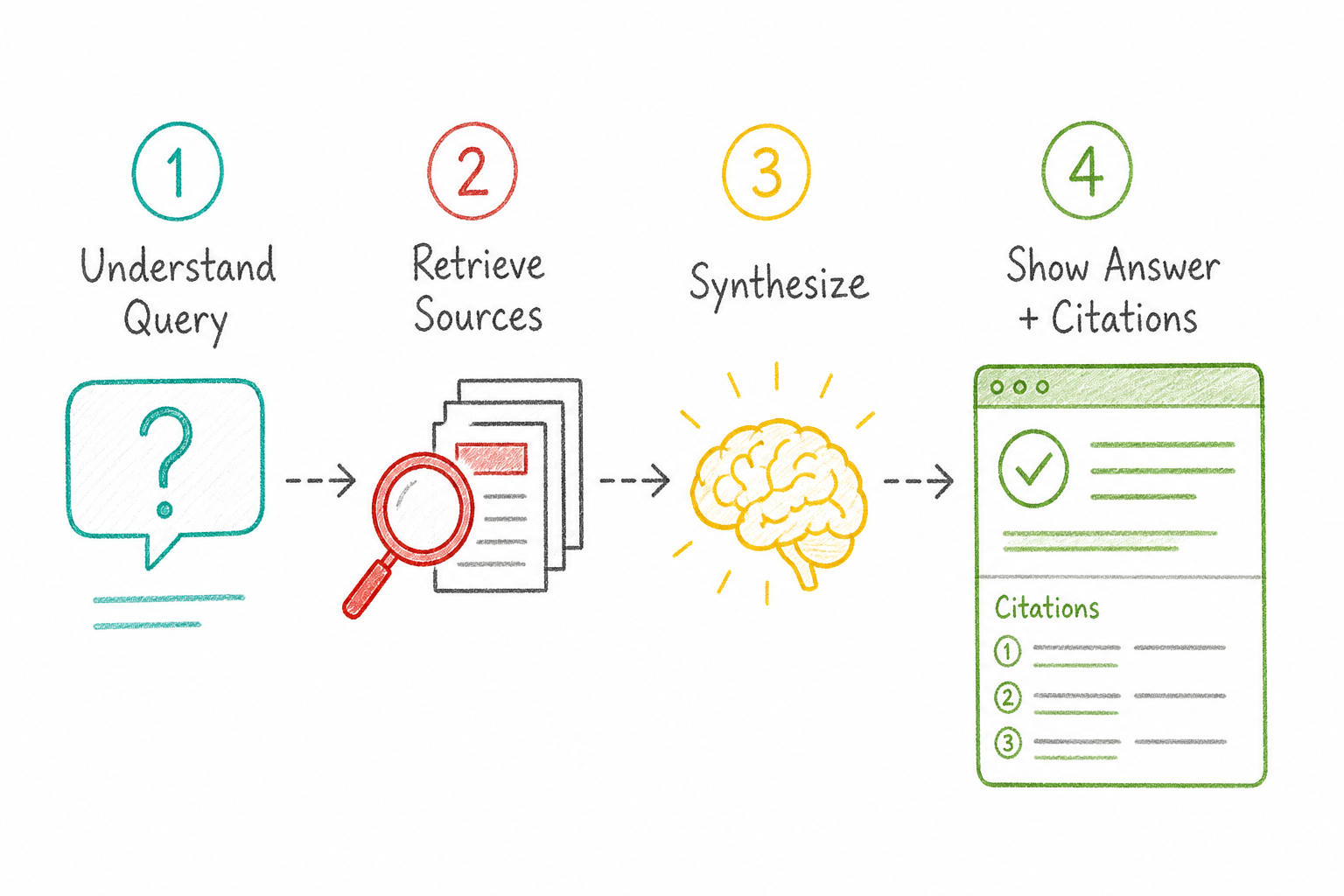
1. Understand the query
The system analyzes what the user wants, including context, constraints, and related meaning.
For example, the question
How should a factory choose an SEO agency?
The system might break the topic into
- Qualities of an SEO company
- Factory or B2B experience
- Pricing
- Case studies
- Technical SEO
- How to measure leads
Google calls the process of generating multiple sub-queries Query Fan-out.
2. Retrieve sources
The system may search a search index, web crawlers, databases, or platform-specific data sources.
For Google AI Overviews and AI Mode, sites must pass the same fundamentals as Google Search: crawlable, indexed, and eligible to show snippets.
3. Evaluate and synthesize information
The system compares data from multiple sources, looks for consistency, and combines information into an answer.
Some systems use Retrieval-Augmented Generation (RAG), which adds external source data to the model before generating a response.
4. Show the answer and citations
Platforms may show
- Site names
- Citations
- Links
- Images
- Product listings
- Maps
- Suggested questions
Being used by AI does not mean a link or brand name appears every time. Citation format depends on the platform and question.
How is GEO different from SEO?
GEO and SEO differ somewhat in outcome goals but share much of the same foundation.
| Topic | SEO | GEO |
|---|---|---|
| Primary goal | Visibility and clicks from search results | Being used, cited, or mentioned in AI answers |
| Result format | Links, snippets, images, video, local results | Synthesized answers, citations, brand mentions |
| Search input | Keywords and queries | Conversational questions and query fan-out |
| Metrics | Ranking, impressions, clicks, organic conversion | Citations, mentions, AI share of voice, AI referral |
| Technical foundation | Crawl, index, render, page experience | Must be accessible and retrievable in the same way |
| Content | Matches search intent and quality | Must answer the question, be verifiable, and cite-worthy |
| Authority | Links, brand, reputation | Source authority, brand consistency, external mentions |
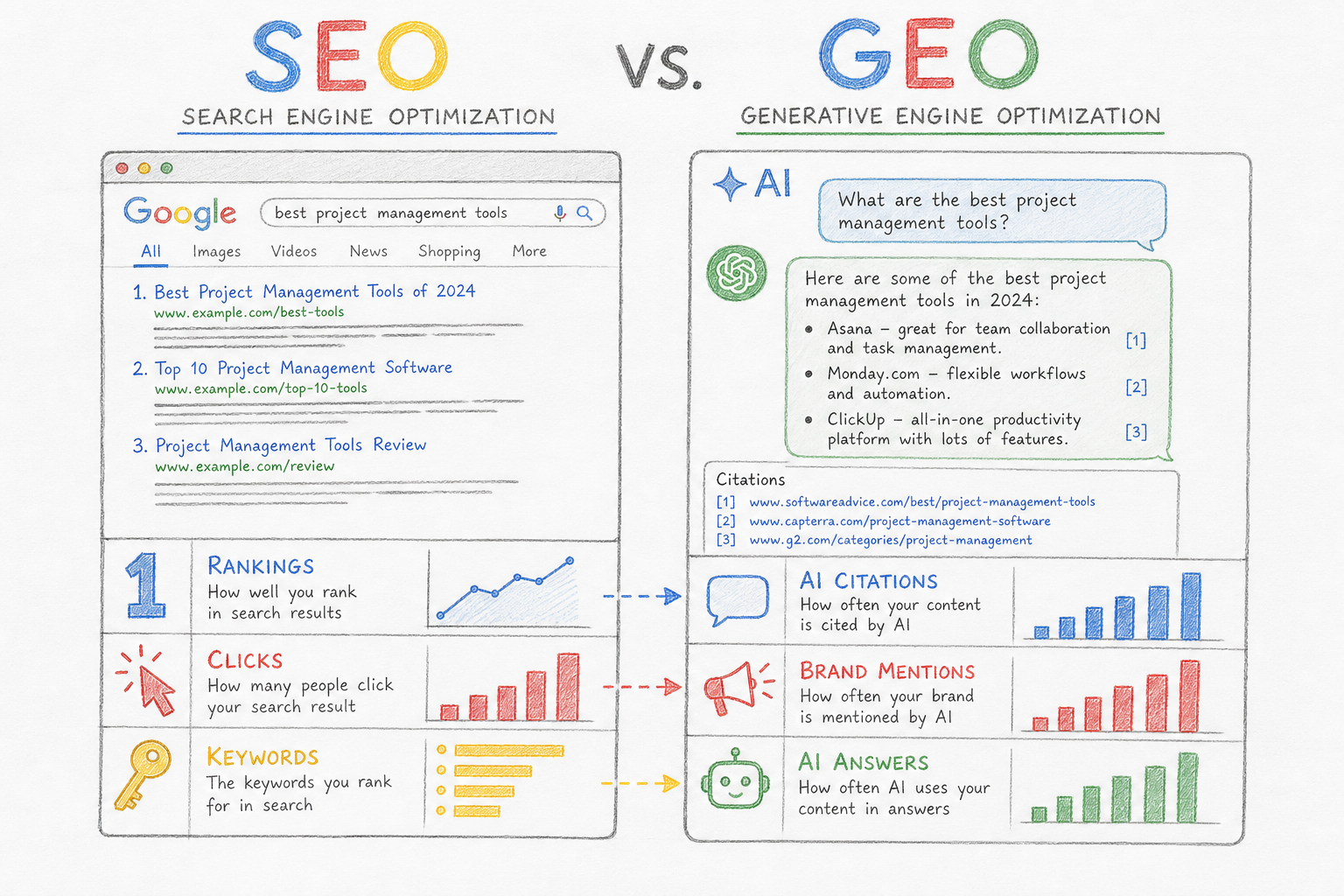
The idea that “SEO focuses on keywords while GEO focuses on quality” is not fully correct.
Modern SEO already emphasizes search intent, quality, and user experience. GEO still depends on technical discovery, content, and authority — just like SEO.
For Google, GEO is not a separate system from SEO, because AI search uses the same search and quality foundations.
Will GEO replace SEO?
No.
Google states clearly that SEO fundamentals still apply to AI Overviews and AI Mode, because Google’s generative AI pulls from the search index and existing ranking systems.
If a page
- Cannot be accessed by Google
- Is not indexed
- Is not eligible for snippets
- Has low-quality content
- Duplicates other pages
- Performs poorly on mobile
it is unlikely to appear in Google’s generative AI search.
The right approach is not to stop SEO and switch to GEO, but to extend measurement and content creation to cover both search results and AI-generated answers.
Why does GEO matter for business?
Search behavior is changing
Users can ask complex questions with constraints in one go, such as
Compare WordPress website agencies in Bangkok for B2B businesses that need SEO and have a budget under 200,000 baht.
Questions like this are longer and more contextual than classic keyword searches.
Businesses need clear enough data for systems to understand and compare them.
AI may shape decisions before purchase
Users may ask AI to
- List providers
- Compare products
- Summarize pros and cons
- Check pricing
- Find reviews
- Build checklists
- Narrow initial options
If brand information is unclear, outdated, or missing from sources systems can access, the business may not appear in the first set of options.
Zero-click search raises the value of brand visibility
Users may get answers without clicking your site.
In that case, a brand mention or citation can still matter even without a direct session, because it helps users learn the brand and search for it later.
Search is not only on Google
Users spread across ChatGPT, Perplexity, Copilot, and niche platforms.
Tracking only Google rankings may not cover the full search journey.
What content is more likely to be cited by AI?
No format guarantees citation, but content with these traits is usually more ready for search and reuse.
Answer the question directly
Include a short, clear answer early in the section before details.
Example:
GEO, or Generative Engine Optimization, is improving content and brand information to increase the chance AI search systems use or cite your information in answers.
That answer should be understandable without reading several paragraphs first.
Include information that is hard to find elsewhere
Google calls this Non-commodity Content.
Examples include
- Real customer data
- Surveys
- Case studies
- Internal processes
- Experiment results
- Screenshots
- Templates
- Tools
- Expert commentary
Articles that only summarize what AI could write on its own are less likely to stand out.
Cite primary sources
When you mention statistics, policies, or research, link to the original source — not a chain of articles citing each other.
Name the source, date, and context of the data.
State limitations
Credible content should not only list benefits.
For example, if you say a method increased AI visibility by 40%, explain that it was a maximum in an experiment — not an average outcome for every site type.
Use readable structure
Use
- H1, H2, and H3
- Short paragraphs
- Bullet lists
- Numbered steps
- Comparison tables
- FAQs
Structure helps readers. You do not need to chop content into unnatural tiny chunks, because Google states there is no requirement to chunk content for AI.
Show author and dates
Pages should show
- Author name
- Relevant experience
- Published date
- Updated date
- References
- Data collection methods when research is involved
Do not change the year in the title without reviewing and updating the actual content.
How to do GEO step by step
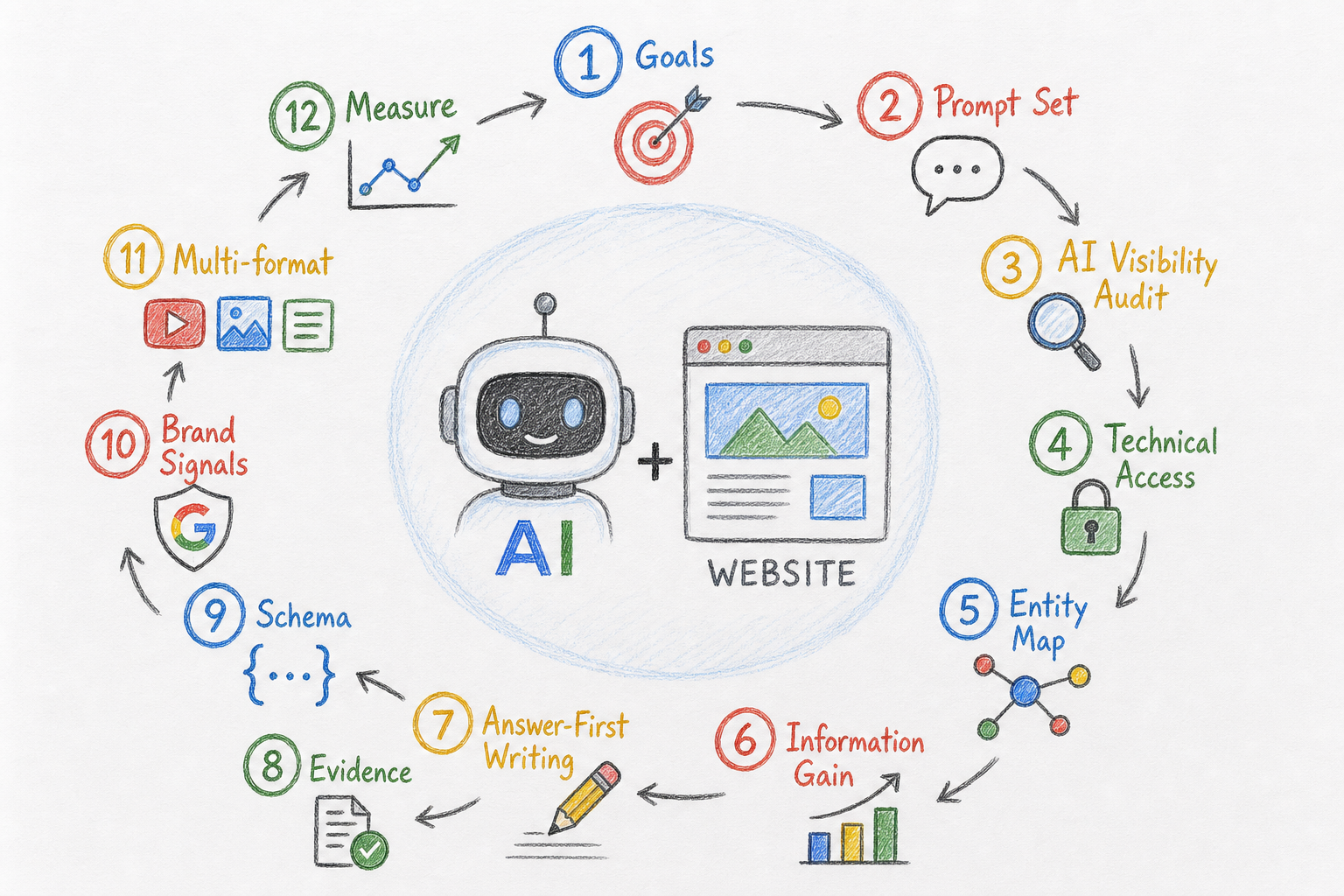
1. Set goals and platforms
Start by asking what GEO should produce.
- Brand awareness
- AI citations
- Referral traffic
- Leads
- Product discovery
- Reputation
- Customer support
Then choose platforms that matter to your audience, such as Google AI Search, ChatGPT, or Perplexity.
You do not need to invest equally in every platform.
2. Build a question set to track
AI search uses a wider range of questions than classic keyword tracking.
Examples for an SEO company
- Where are SEO agencies in Thailand?
- How should a B2B business choose an SEO company?
- Compare SEO agencies in Bangkok
- How much does SEO cost?
- SEO companies that measure leads
- SEO agencies that support AI search
Group questions by intent and customer journey, then retest with the same set on a schedule.
3. Audit current AI visibility
Record for each platform whether it
- Mentions your brand
- Describes your brand correctly
- Cites which URLs
- Mentions which competitors
- Uses which sources
- Contains wrong or outdated information
AI outputs can change over time, by account, and by context. Measurement needs a consistent method.
4. Check technical accessibility
For Google, verify that
- Googlebot can crawl
- Pages are indexed
- Pages can show snippets
- Canonicals are correct
- Important content is in accessible HTML
- Internal links are clear
- Mobile works well
- Page experience is sound
For other platforms, check each crawler’s policy and user-agent in robots.txt.
Separate search crawlers from training crawlers — purposes may differ. Businesses should decide based on their own data policies.
5. Map topics and entities
Identify what your brand should be known for and which entities are involved.
Examples:
Brand
- Serplit
Services
- SEO
- Technical SEO
- Content SEO
- Web design
- WordPress
Audiences
- SMEs
- B2B
- Factories
- Service businesses
Locations
- Bangkok
- Thailand
Then build service pages, articles, case studies, and company information that connect together.
Read foundational guidance at What Is Content Marketing.
6. Create information gain
Before creating content, ask what your site can add that current results do not already provide.
Examples
- AI visibility reports for Thai businesses
- Before-and-after case studies
- Referral traffic data from AI
- Prompt sets to check brand mentions
- GEO readiness assessments
- Commentary from Thai experts
- Experiments with Thai-language questions
Original research is more likely to be cited by websites and AI systems than generic definition articles.
7. Write answer-first
Each section should start with the answer before details.
A usable structure is
- Direct answer
- Reason
- Evidence
- Examples
- Limitations
- Next steps
You do not need stiff language or bot-focused writing. Clear natural language works for people and AI.
8. Add evidence and citations
Use
- Official documents
- Research
- Statistics with dates
- Expert quotes
- Case studies
- Methodology
- Screenshots
- Data tables
Verify links still work and that your text matches the primary source.
9. Use structured data by page type
Structured data helps search engines understand information and can qualify pages for some rich results.
Schema types that may fit include
- Article
- Organization
- Person
- Product
- LocalBusiness
- BreadcrumbList
- VideoObject
Schema must match what users actually see on the page.
Google states structured data is not required for generative AI search and no special schema guarantees AI citation.
10. Build brand signals naturally
Keep brand information consistent across
- Company website
- Social profiles
- Google Business Profile
- Partner websites
- Associations
- Events
- News
- Podcasts
- YouTube
- Review platforms
Avoid fake mentions or spam, because Google states inauthentic mentions are not an effective shortcut.
11. Publish multiple formats when useful
One topic can appear as
- Article
- Video
- Infographic
- Podcast
- Webinar
- Slides
- Checklist
- Tool
You do not need every format. Each one should add value and fit the audience.
12. Measure and improve
Track both AI and organic search for the full picture.
If citations rise but traffic does not, brand awareness may still benefit.
If AI traffic rises but conversions do not, review landing pages, offers, and tracking.
How does GEO differ by platform?
Google AI Overviews and AI Mode
Uses Google Search foundations.
What matters
- Crawlable and indexed
- Distinctly valuable content
- Strong foundational SEO
- Accurate product and business data
- Internal links
- Page experience
- Relevant images and video
Google states you do not need new content made only for AI, and no special markup is required.
ChatGPT Search
Check whether your site allows the relevant OpenAI search crawlers per policy.
Improve odds with clear brand information, trustworthy references, and pages accessible without login.
Perplexity
Perplexity highlights citations, so use verifiable statements, primary references, and pages crawlers can access.
Microsoft Copilot
Bing index matters. Check Bing Webmaster Tools, sitemaps, and indexing in addition to Google.
No single method guarantees results on every platform, because each system uses different sources and citation selection methods.
Is llms.txt required for GEO?
llms.txt is a proposal for sites to list content for large language systems in an easy-to-read format.
It is not yet a standard every major AI search platform supports.
Google states it does not use llms.txt to display sites in Search or generative AI features.
You can experiment if cost is low, but it should not outrank
- Crawlability
- Indexing
- Content quality
- Internal links
- Author information
- Primary sources
- Brand consistency
Having llms.txt does not guarantee AI citation.
Does E-E-A-T matter for GEO?
E-E-A-T stands for
- Experience
- Expertise
- Authoritativeness
- Trustworthiness
E-E-A-T is not a single ranking score you can boost with a plugin or schema.
But the framework helps assess whether content shows enough experience, expertise, and trust.
Practical steps include
- Name the author
- Show relevant experience
- Explain how data was collected
- Cite primary sources
- Disclose conflicts of interest
- Show contact information
- Correct errors
- Update content when information changes
Especially for health, finance, legal, and safety topics, have experts review content.
Can you use AI to create GEO content?
Yes, but publishers remain responsible for quality.
AI can help with
- Ideas
- Grouping questions
- Summarizing documents
- Outlines
- Table formats
- Redundancy checks
- Language polish
Humans should verify
- Facts
- Dates
- Numbers
- References
- People’s names
- Product information
- Experience AI invented
- Alignment with the business
Do not mass-produce articles for every prompt variation, because Google states creating many pages to manipulate search or AI responses may qualify as scaled content abuse.
Common GEO misconceptions
SEO no longer matters
Not true — especially for Google AI search, which uses the search index and existing quality systems.
Add schema and AI will pick your site
Not true. Schema helps explain data but does not guarantee citation.
AI only likes human-written content
No evidence shows platforms judge quality only by whether a human or AI wrote it. Quality, accuracy, and usefulness matter.
Updating the year in the title keeps content fresh
Changing the year without updating information is not a meaningful update.
Every page needs FAQs
FAQs help when there are real questions. Duplicate or irrelevant questions do not automatically make AI choose the page.
You must write very short paragraphs for AI
Google states there is no requirement to chunk content into tiny pieces. Clarity and usefulness for readers matter more.
Mass mentions make AI trust you
Fake or spam mentions are not sustainable authority. Build mentions from real work and relevant sources.
How to measure GEO
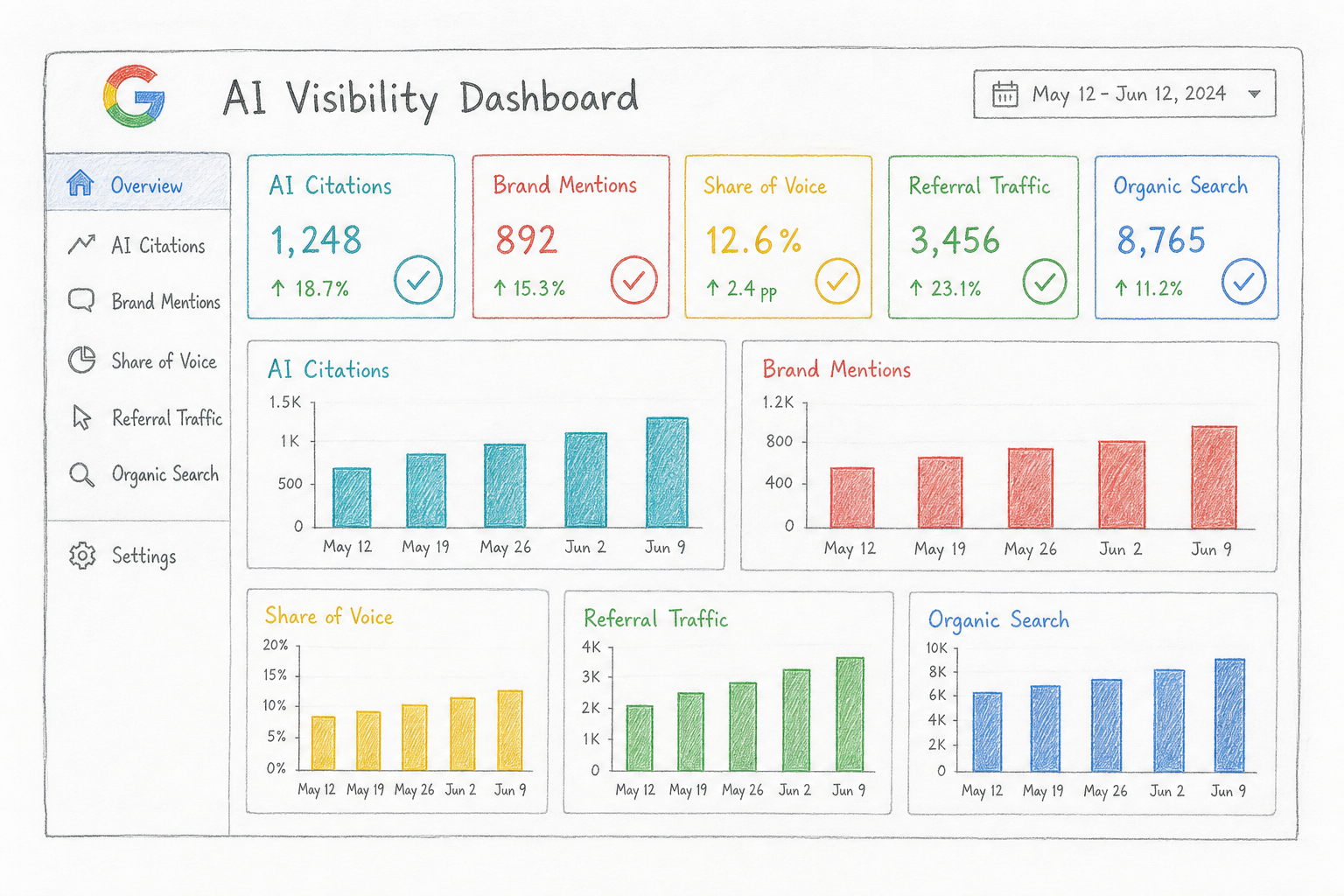
AI Citation
Check whether your site’s URLs are used as references.
Brand Mention
Check whether AI mentions your brand, products, or experts even without a link.
AI Share of Voice
Compare your brand’s share of appearances against competitors on the same question set.
Citation Accuracy
Check whether AI describes your brand, pricing, services, and features correctly.
AI Referral Traffic
Use analytics to review referrals from AI platforms where those platforms pass data.
Assisted Conversion
Check whether AI search played a role in the customer journey before a lead or sale.
Organic Search Metrics
Track alongside
- Impressions
- Clicks
- Rankings
- Organic traffic
- Conversions
AI outputs can change often. Use consistent prompt sets, regions, languages, accounts, and review cycles.
GEO Checklist
Content
- Direct answer early in each section
- Unique data or perspective
- Primary source citations
- Dates and author listed
- Limitations explained
- Verifiable examples
- No statistics without sources
Structure
- Clear H1, H2, and H3
- Readable paragraphs
- Tables when they help comparison
- FAQs for real questions
- Internal links to related pages
- Important content in text form
Technical
- Pages are crawlable
- Pages are indexed
- Canonicals are correct
- Server responds normally
- Mobile-friendly
- No main content hidden behind login
- Structured data matches on-page content
- AI crawler policies reviewed
Authority
- Author bio present
- Consistent brand information
- Case studies available
- Natural mentions from other sources
- Clear contact and policies
- Information updated when it changes
Measurement
- Prompt set for tracking
- Citations and mentions logged
- AI referral tracked
- Leads and conversions measured
- Competitors compared with the same method
Summary
GEO is improving content, your website, and brand information to increase the chance generative AI systems discover, understand, and cite or use your information in answers.
GEO does not replace SEO. It adds new dimensions beyond rankings and clicks:
- AI citations
- Brand mentions
- AI visibility
- Citation accuracy
- AI referral traffic
- Assisted conversions
The foundations that still matter are
- The site is accessible and indexed
- Content answers real questions
- You offer information that is hard to find elsewhere
- You cite primary sources
- You show authors and accountability
- You build brand authority naturally
- You measure with a consistent method
For Google, you do not need llms.txt, AI schema, or separate AI-only content to appear in AI Overviews.
Invest first in foundational SEO, content with information gain, and accurate brand information.
For a search strategy that covers both Google and AI search, see GEO services, SEO services, and Content SEO services.
Frequently asked questions
What is GEO?
GEO, or Generative Engine Optimization, is improving content, your website, and brand information to increase the chance AI search systems discover, understand, and cite or use your information in answers.
How is GEO different from SEO?
SEO focuses on visibility and clicks from search results. GEO adds being selected as a source in AI answers. Both share foundations like quality content, trust, and technical SEO.
Does GEO replace SEO?
No. Especially on Google, which uses the same search index and quality systems for AI Overviews and AI Mode. Sites still need SEO to be discovered and indexed first.
Does Schema Markup help AI cite your website?
Schema helps explain data and can qualify pages for some rich results, but Google states structured data is not required for generative AI search and no special schema guarantees AI citation.
Do you need llms.txt for GEO?
Not for Google Search. Google states it does not use llms.txt for generative AI features today. You can experiment with it, but it should not outrank foundational SEO.
Can you use AI to write GEO content?
Yes, if humans verify facts, add experience or proprietary data, and keep content useful. Google does not ban AI-generated content by default, but opposes low-quality scaled content made to manipulate rankings.
How do you measure GEO?
Track AI citations, brand mentions, share of voice, referral traffic from AI platforms, landing pages, and conversions with AI search in the journey — alongside organic search.